
Permanent Magnetic Materials
Magnetization types, magnetic and physical propertiesA material is referred to as permanent magnetic when, after being exposed to a magnetic field, a high portion of magnetism remains in the material and when a strong opposing field is required to eliminate this stable magnetization. Many technical developments only became possible once industry succeeded in producing exceptionally strong permanent magnets in various shapes and dimensions. In contrast to conventional soft iron magnets, modern magnetic materials possess a high degree of permanent magnetism. For some variants, a lifetime guarantee for the magnetic properties (under normal operating conditions) is provided. They are manufactured in a wide range of shapes and sizes: as blocks, discs, rods, rings, cylinders, etc.
Permanent magnets can be divided into three main groups: 1. Ceramic magnets 2. Rare-earth magnets 3. Steel magnets
Fields of Application
The fields of application for permanent magnets are unlimited. The following overview focuses on the main areas of use:
- Lifting, clamping, holding, and separation systems
- Fixture construction and automotive engineering
- Telecommunications and measuring technology
- Motor and generator construction
- Couplings and braking systems
- IT, audio, video, and speaker systems
- Security systems
- Planning aids and decorative tools
Specific Properties
Which material is best suited for which application?
The answer depends on the requirements placed on the magnet, such as the available space and the required magnetic force.
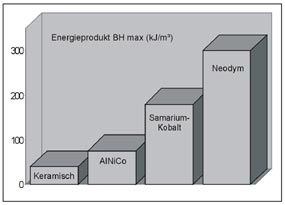
The graphic shows a comparison of magnetic strength relative to dimensions. It is clearly visible that, with identical dimensions, a neodymium magnet has a magnetic force roughly five times higher than that of a ceramic magnet. In addition to the size and holding force of a magnet, mechanical requirements (e.g. stability of the magnetic field), cost considerations, and operating temperature play an important role in selecting the optimal magnetic material. If the ambient temperature is too high, the magnetic properties may significantly decrease or even be lost entirely. The table below compares the most important properties of modern permanent magnetic materials.
Types of Magnetization
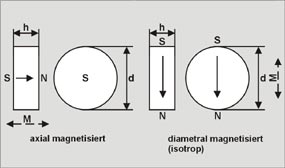
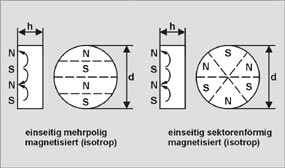
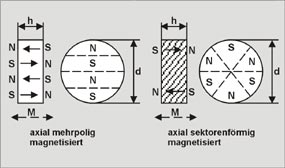
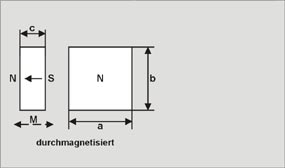
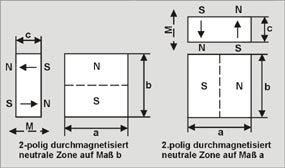
Permanent magnets can be magnetized in many different ways. A number of commonly used magnetization orientations are shown below:
Product Materials and Tolerances
Magnets shrink during sintering. The resulting tolerances depend on the production method, final shape, and size of the magnet.
We reserve the right to make changes in quality and design.
WARNING: The strong or very strong magnetic field of permanent magnets made of ferrite, AlNiCo, samarium-cobalt, and neodymium materials can interfere with or destroy electronic devices, measuring instruments, screens, and all magnetic data carriers (disks, credit cards, audio and video tapes), as well as pacemakers. Handling Instructions for Raw Magnets (PDF)